
The Spell to Stop Shrinking: Staying True to Who You Are in Relationship
I had a conversation with a friend recently that felt like looking into a mirror—not just of her life, but of my own past, and maybe even a glimpse of what could be if I’m not paying attention.
She’s been struggling in her marriage for years. Not in a loud, explosive way, but in the quieter, more disorienting way where something essential feels missing and life keeps moving anyway. She doesn’t feel fully seen, fully heard, or fully desired. She’s tried to name it, gently and directly, over and over again. She’s done the therapy. She’s taken responsibility for her own growth. She’s even adjusted her life to try to reduce the pressure her partner says he feels. And still, nothing really moves.
Listening to her, I felt that familiar ache—not just empathy, but recognition. The slow erosion that happens when you can feel something is off, but the other person either can’t or won’t meet you there. The way you start to question yourself. The way your energy goes into trying to articulate something that feels so obvious in your body but somehow never quite lands in conversation.
Over time, that unmet energy doesn’t simply disappear. It finds expression somewhere. Sometimes it shows up in the body as stress, exhaustion, or depletion. Sometimes it moves toward another connection—someone who can meet you in the place that has gone untouched for too long. Sometimes it becomes a quiet resentment that builds so gradually you don’t even recognize it until it’s everywhere. But underneath all of it is the same root: something true wasn’t being honored.
I think many of us sense these misalignments earlier than we want to admit. Not as a clear thought, but as a feeling—a tension, a subtle contraction in the body, a knowing that something about the dynamic isn’t quite right. And then comes the question: do I stay with what I feel, or do I adapt to keep the relationship intact?
For a long time, I chose adaptation. I compromised. I softened my edges. I told myself that relationships require flexibility, that love means meeting in the middle, and that not everything has to be perfect. And none of that is inherently wrong. But there is a difference between compromise and self-abandonment, and I didn’t always know where that line was.
I’m starting to understand it now in a much simpler way. Some compromises expand you, and others shrink you. Some feel like growth—a stretching into something new, a willingness to meet another person without losing yourself. Others feel like contraction—a quiet closing, a subtle silencing of your own desires in the hope that it will make the relationship work. The tricky part is that both can look the same from the outside. You are still being flexible. You are still meeting them where they are. But your body knows the difference.
One kind of compromise leaves you feeling more like yourself. The other leaves you feeling less. I’ve been noticing this in real time lately—in the small moments, in the choices about how I spend an evening, in whether I follow my own desire or override it in the name of connection. It shows up in whether I speak what I want or wait to see what the other person does first. It’s subtle, but it is everything.
Because when you abandon yourself in small ways, consistently, it doesn’t create more love. It creates distance, even if everything looks fine on the surface. And eventually, that distance asks to be resolved, sometimes gently and sometimes not.
I don’t want to live that way anymore. Not from a place of rigidity or “my way or the highway,” but from a place of integrity—a willingness to stay connected to what is true for me, even in the presence of another person I care about. That might mean saying, “I don’t actually want to spend the night on the couch watching TV—what else could we do?” It might mean noticing when I’m defaulting into being the one who holds and allowing myself to be held instead. It might mean recognizing when something feels off and not rushing to explain it away.
It doesn’t mean there won’t be compromise. There will be. There has to be. But I want my compromises to feel like expansion, not contraction—like growth, not quiet resignation. I want to feel more alive in my relationships, not less.
And maybe that’s the real work—not finding the perfect person, but becoming someone who stays in relationship with their own truth, even when it would be easier not to. Because love that requires you to leave yourself isn’t actually love. It’s just something we learn to survive.
And I’m no longer interested in surviving my relationships. I want to be fully in them, fully myself, and fully alive.

The Expansion Over Contraction Spell
A spell for choosing integrity over self-abandonment in love
Intention
To recognize the difference between expansion and contraction in my body, and to choose connection that allows me to remain fully myself.
Materials
A mirror (handheld or standing)
A candle (white or soft gold)
A piece of paper and pen
One object that feels grounding or true to you (a stone, a ring, a piece of fabric)
The Ritual
1. Create the container
Light your candle. Let this mark the shift from thinking about your life to being inside it consciously.
2. Map your experience
Sit with your paper and draw a line down the center. At the top of one column, write: Expansion. At the top of the other, write: Contraction.
Without overthinking, begin to write.
Under Expansion, list the ways you feel in connection when you are most yourself—open, playful, turned on, grounded, curious, soft, expressed, alive.
Under Contraction, list the ways you feel when you are abandoning yourself, even subtly—tight, quiet, accommodating, performing, waiting, small, managing, unsure.
Let this be honest. Let it be yours.
3. Feel the difference
When you are finished, place your hand on each column, one at a time. Notice what happens in your body as you touch Expansion. Then notice what happens as you touch Contraction. You are not trying to change anything—only to recognize.
4. Anchor in truth
Take your grounding object in your hand and stand in front of the mirror. Look at yourself—not critically, but as though you are witnessing someone you care deeply about.
And say, slowly:
I trust what I feel.
I honor what expands me.
I release what requires me to be small.
I am allowed to be fully myself in love.
Pause. Let the words land.
5. Choose what you keep
Fold the paper in half, separating Expansion from Contraction. Keep the Expansion side somewhere visible—a quiet reminder of your truth. You may discard, tear, burn, or bury the Contraction side if that feels right, or simply set it aside.
6. Close the ritual
Blow out the candle, carrying the awareness with you.
Integration
Over the next few days, notice your body in real time. When you are with someone, or even thinking about them, gently ask: Does this feel like expansion… or contraction? You do not need to act immediately. Just notice. This is how the spell begins to live inside you.
Closing
This spell is not about becoming perfect in your choices. It is about becoming honest in your experience. And from that place, allowing your life—and your love—to organize itself around what is true.
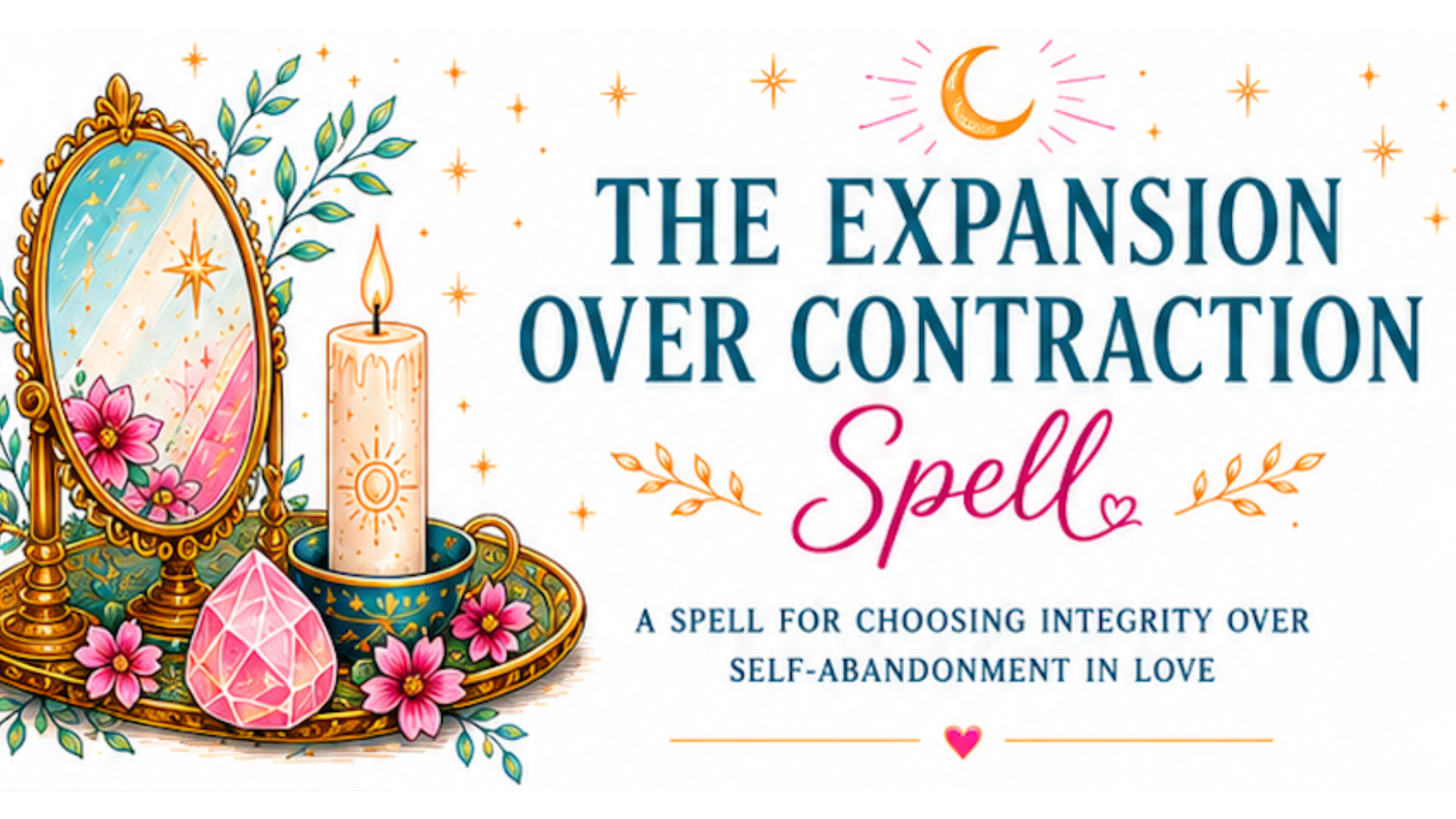
Download this Grimoire page and cast a spell to allow yourself to expand in love
What expands you is not asking you to prove your worth—it’s asking you to trust your truth. If you’re ready to follow that feeling in love, Love Spell Casting helps you recognize it and choose it with intention.