
Power Is a Delicate Knife: The Day I Pulled a Tarot Card for My Divorce Attorney
When my ex-husband and I were meeting with the mediator facilitating our divorce, there was a day when the three of us sat around a table in his office while he casually explained that every separation agreement had to, by law, include language describing why the marriage was no longer sustainable. He said these agreements become public record, so he joked that we probably wouldn’t want ours to say, “because he’s a drunk” or “she’s a witch.”
I smiled, looked at the attorney, and said truthfully, “I am a witch.”
He immediately slapped his hand on the table and said, “Oh no you’re not,” trying, I suspect, to comfort or reassure me.
I smiled again. “Yes I am.”
His whole demeanor changed then. The joking tone faded. He looked me dead in the eye, almost pleading through his pupils, and said, “I promise I’ll be good.”
I was taken aback by the earnestness of it, the fear threaded through the humor. In that moment he surrendered something important to me: his belief. I hadn’t asked for that exactly. I just wanted to be seen in a moment where I felt very small, where I felt like a villain for walking away from a life I thought everyone else viewed as a prize.
Trying to soften the tension, I laughed and said, “I’m a nice witch.”
We went through the rest of the meeting, Andrew and I initialing documents, signing our marriage away, and at the end I looked at the attorney and asked, “Would you like me to pull a tarot card for you?”
I watched Andrew squirm in his seat. He started to stand up, saying, “I have a shoot I have to get to.”
But without hesitation, the attorney said yes.
I asked if he had a question in mind.
“Yes, actually,” he said. “I’ve been trying to figure out whether or not I should retire. I love my work. It’s given me purpose, and I don’t know if I’m ready to let it go. My wife wants me to retire.”
I shuffled the cards, my eyes focused on the deck in my hands, though I could still see Andrew in my periphery. He was tense, taut, but he hadn’t left after all.
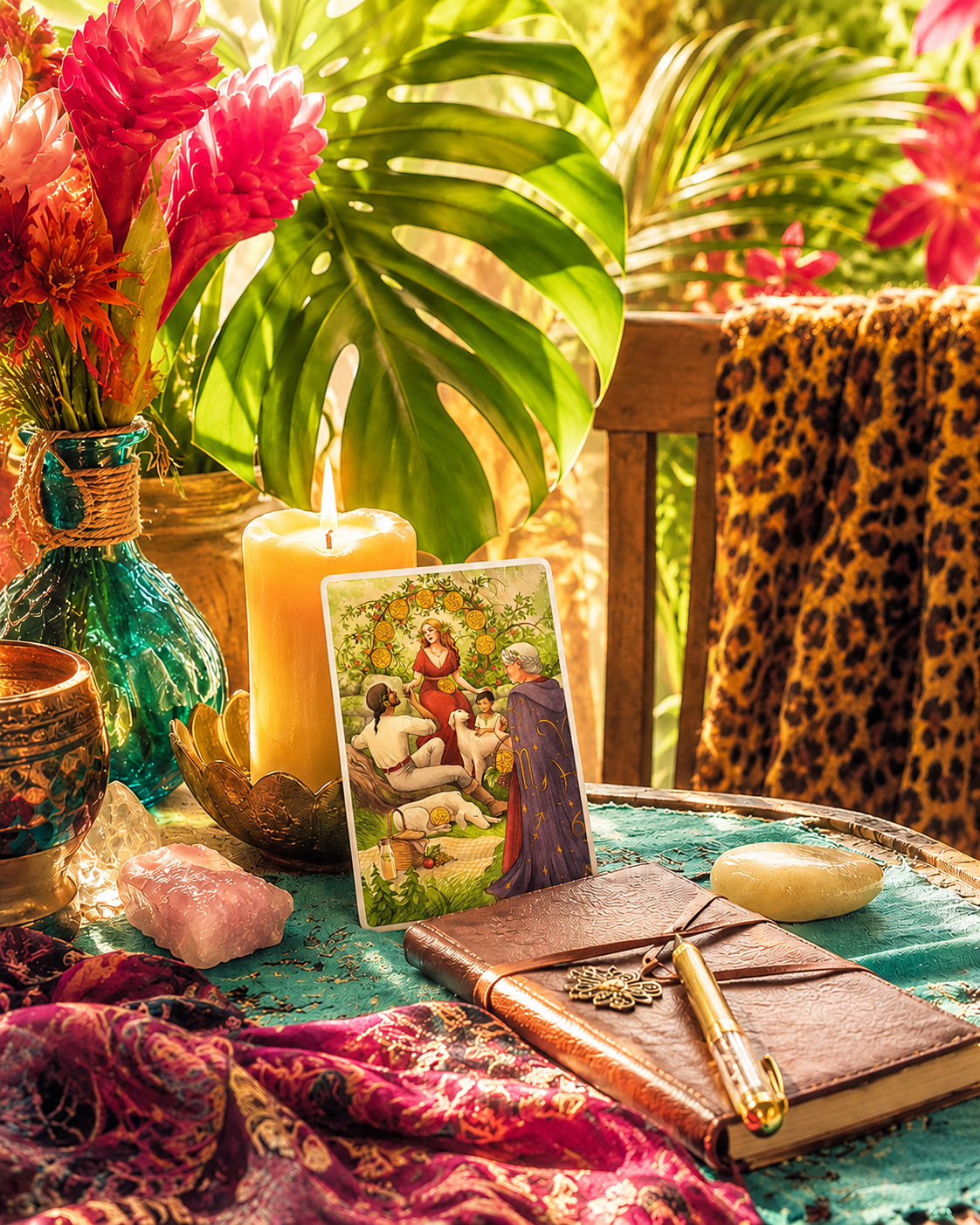
I pulled the Ten of Pentacles, a card in my deck depicting a beautiful young woman sitting on a stone wall. One hand is held by a handsome man looking up at her with admiration, and the other rests gently on the head of a little boy. Two content white dogs and an older woman in a purple cape with a tender smile round out the scene.
I asked the attorney what he saw in the card.
“Family,” he said.
“How does it make you feel?”
“They look so happy,” he said softly. “I want to be there.”
I looked at him and said, “It sounds like you have your answer.”
He paused for a moment.
“Yes,” he said. Then after another pause: “And there’s something to be said for going out while I still have all my faculties. I’m still healthy.”
I asked him if we could share a hug, and he said yes.
As we were leaving his office, he asked me, “So you’re a pharmacist?”
“Yes,” I said. “I’m a pharmacist witch. I wrote a book about it.”
“Where can I find it?”
***
This moment in my life feels layered with meaning.
Toward the end of my marriage, Andrew and I barely spoke. The walls between us had become so thick there was very little either of us could say or do to reach the other. His anxiety about money as I tried to build a business consumed a tremendous amount of emotional energy for both of us. So did our grief and divergence around children after my miscarriage. But beneath those visible conflicts were deeper differences in how we imagined a meaningful life.
I wanted transformation. Freedom. Experimentation. I wanted to grow stranger and more fully myself. I wanted a life spacious enough to hold reinvention. Andrew longed for something more stable and recognizable: children, routines, suburban rhythms, predictability, daily comforts, a future that felt secure and familiar. Neither of these desires made us wrong. But over time, we became increasingly unable to recognize ourselves inside the life we were building together.
Money became one of the primary languages through which our fear and disappointment expressed themselves. I was not earning a sustainable living building a business around holistic health coaching and spiritually integrated work, and I understood why that frightened him. I was frightened too sometimes. And yet what I longed for most was not merely financial patience, but belief. I wanted him to believe that my becoming mattered. That I mattered.
One day during an argument he said sharply, “I’d actually like to be able to retire someday,” and I remember hearing beneath the sentence an exhaustion neither of us knew how to soothe and salt in a wound I didn’t know how to heal.
I tried hard to remain someone he could love. I tried for the baby I did not truly want. I went to his parents’ house every Wednesday I could and smiled through the depletion of my pharmacist work. I shielded him from the burden of my student loans. I tried to make myself easier to carry. But eventually I realized that staying required a continual abandonment of my own wanting. And something in me began disappearing.
At the end, the only activities that still seemed possible for us to do together were driving silently while listening to the same songs, each of us wandering elsewhere in our minds, or bicycling side by side, moving in the same direction without asking whether it was actually where either of us wanted to go. It became profoundly lonely to be together.
Eventually, the part of me that remained felt unable to imagine surviving that cage. In a kind of dissociated haze, I packed my things and went home to my mother to remember what love without constant negotiation felt like again.
And all the while, I felt like the villain for being the one who left. I knew the marriage needed to end for both our sakes, but knowing something is necessary does not prevent grief and shame from attaching themselves to the choice.
But in that attorney’s office, something shifted. For a moment, I felt visible again. Not because I had power over anyone, but because I no longer felt ashamed of my own becoming.
I could feel Andrew’s discomfort as I stepped more openly into my witchiness, but I realized then that what hurt most in our marriage had not been disagreement alone. It was the feeling that parts of me had become unwelcome. Too strange. Too risky. Too inconvenient to build a future around. And at the same time, I was struck by something else entirely: the attorney did not become smaller in my presence. He became more honest. That distinction matters deeply to me. When I pulled that tarot card, I did not tell him what to do. I did not claim authority over his life. I did not need him to surrender his judgment to me. If anything, the moment felt meaningful because it moved in the opposite direction: toward his own inner knowing. He already knew what he wanted. The card simply helped create enough stillness for him to hear himself say it aloud.
I think often now about the nature of power. Power is such a delicate knife. We can use it to diminish, dominate, manipulate, or sever people from themselves. But we can also use it to cut through shame, illusion, fear, and the old bindings that keep us disconnected from our own lives.
The version of witchcraft that feels true to me is not about taking power from anyone else. It is about becoming more deeply responsible for the power already living within yourself. And this is not always comfortable. Sometimes becoming more fully yourself disrupts existing systems, relationships, identities, and expectations. Sometimes your liberation hurts people—not because freedom is cruel, but because change rearranges realities. Endings ache. Disappointment aches. Divergence aches.
But there is a difference between causing pain and committing harm. I no longer believe goodness requires self-erasure. And perhaps that is the real fear many of us carry when we begin becoming more powerful: not simply that others will reject us, but that we ourselves will become monstrous in our freedom.
Maybe the deeper question is not whether the witch is the villain. Maybe the question is whether she can remain humane while becoming free. That, to me, feels like the real work.
A Spell for Releasing the Villain Story
A spell for grief, self-forgiveness, and becoming trustworthy to yourself again
Intention
To release the belief that choosing yourself makes you cruel.
To honor grief without turning it into punishment.
To soften the need to carry every ending as evidence of failure.
To move from self-condemnation toward self-trust.
Materials
A bowl of water
A small stone or rock that fits comfortably in your hand
A candle
A piece of paper
A pen
Something soft: a blanket, sweater, shawl, or pillow
Optional:
A photograph or object connected to what you are grieving
Music that feels tender but spacious
Dirt, leaves, flowers, or another natural element to remind you that endings are part of life itself
The Ritual
1. Create a quiet threshold.
Light the candle.
Place the bowl of water beside it.
Let this moment become slightly different from the rest of your day—not dramatic, not performative. Simply intentional.
Wrap yourself in something soft.
You do not need to arrive composed.
You do not need to arrive wise.
You only need to arrive honest.
2. Hold the stone.
Place the stone in your hand and sit quietly for a moment.
Imagine this stone carrying every accusation you have made against yourself:
selfish
cruel
abandoning
too much
not enough
villain
Let the stone become the weight of the story you keep carrying.
Not the grief itself.
The judgment.
Notice how long you have been holding it.
3. Write what was true.
On the paper, write the truth beneath the shame.
Not the polished version.
Not the version designed to make everyone comfortable.
The deeper truth.
Perhaps:
I left because I was disappearing.
I gave her away because I loved her.
I am grieving even though I know it was right.
I am tired of making myself the villain for surviving.
Relief does not erase love.
I am allowed to choose a life that fits my soul.
Write until something inside you softens or cracks open.
4. Speak to the grieving self.
Place one hand over your heart and say:
You do not have to earn the right to grieve.
You do not have to become smaller to prove you are good.
Causing pain is not always the same as causing harm.
Sometimes love releases.
Sometimes truth rearranges lives.
Sometimes becoming requires letting go.
I will not abandon myself to maintain innocence.
Pause after each line.
Let your body hear it.
5. Release the villain story.
Hold the stone over the bowl of water.
Say:
I release the story that my needs make me dangerous.
I release the belief that self-sacrifice is the only proof of love.
I release the burden of carrying every ending as failure.
I choose grief without self-punishment.
I choose tenderness over condemnation.
I choose to become trustworthy to myself.
Drop the stone into the water.
Listen to the sound.
Let it mark the moment.
6. Sit in the space after.
Do not rush to feel transformed.
Just sit.
Notice the candlelight.
Notice your breathing.
Notice the quiet that remains after something heavy is set down.
Grief may still be there.
But perhaps shame does not need to sit beside it anymore.
Closing
The witch is not made dangerous by her freedom.
She becomes dangerous only when she forgets her own humanity.
Let your power remain connected to tenderness.
Let your discernment remain connected to love.
Let your becoming remain connected to truth.
Go forward not as someone who conquered herself,
but as someone willing to belong to herself at last.
Download the Spell PDF to add to your grimoire here:
If you are moving through an ending, a reinvention, or the tender disorientation that can accompany becoming more fully yourself, Reiki can offer a space to soften, reconnect, and be held with compassion while your inner world reorganizes. You do not have to navigate every threshold alone. My Reiki sessions are designed to support the mind, body, heart, and soul as you move gently toward the life that feels most true to you.