
A Spell to Reclaim Your Sacred Energy
For most of my life, I understood work through the lenses I was handed early: school, achievement, productivity, external validation. Work was what earned a grade. Later, it became what earned a paycheck. If something did not produce measurable output, it was easy to dismiss it as optional, indulgent, or somehow less real.
But the longer I live, the less that definition holds.
I am beginning to think that work is not best defined by money, titles, or visible accomplishment. Work is energy spent. Work is anything that requires our life force. Work is anything that asks something of our bodies, our minds, our hearts, or our spirits.
By that definition, far more of life is work than we tend to acknowledge.
Breathing is work. Grieving is work. Healing is work. Making a nourishing meal is work. Moving our bodies is work. Listening deeply to a friend is work. Letting ourselves rest after a hard season is work. Journaling, creating, praying, parenting, tending a home, caring for an animal, rebuilding trust in ourselves after heartbreak, sitting still long enough to hear what we actually feel—all of it is work because all of it requires energy.
This shift matters because many of us have been taught to count only one kind of labor: the kind the world can monetize, measure, and praise. We have been conditioned to believe that only certain expenditures of energy are legitimate, noble, or deserving of structure. And when we do that, we create lives that may look productive on paper but are energetically unsustainable in practice.
We tell ourselves we “worked all day,” but what we often mean is that we gave our energy to a job all day. Meanwhile, we ignore the energetic cost of everything else: the emotional labor of navigating relationships, the physical labor of living in a body, the mental labor of decision-making, the spiritual labor of trying to stay connected to meaning in a disconnected world.
Then we wonder why we are exhausted.
Part of the problem is not that we are lazy, unmotivated, or bad at time management. Part of the problem is that our accounting system is incomplete. We are budgeting our hours without budgeting our energy. We are planning our days around obligations without asking what those obligations actually cost us internally. We are overcommitting not only because we do too much, but because we fail to honor the invisible labor of being human.
When I began stepping away from a more conventional model of work, I had the unexpected privilege of noticing my own energy more clearly. I began to see that I am not a machine designed for endless output. I am a living system with rhythms, limits, needs, and patterns. I began to understand that certain practices are not extras tacked onto life when there is time; they are part of the energetic architecture that makes life possible.
Movement is work. Sleep is work. Cooking is work. Emotional integration is work. Creativity is work. Building community is work. Pleasure, even, can be work in the best sense: a way of restoring vitality, reconnecting to self, and bringing energy back online.
This does not mean every form of work feels heavy. Some work nourishes us as it asks something of us. Some work drains us. Some work does both. But all of it participates in the economy of our energy, and pretending otherwise comes at a cost.
I think many of us are living inside inherited definitions of work that were shaped by scarcity, survival, performance, and productivity culture. They may have helped previous generations endure. They may have helped us achieve. But they are often poorly suited to the kind of healing, wholeness, and consciousness we say we want now.
If we want to live differently, we may need to ask different questions.
Not just: What do I have to do today?
But also: What will this require of me? What replenishes me? What kind of energy does this task ask for? What kind of energy will I have left afterward? Am I building a life that honors the full cost of being alive, or only the parts that can be externally justified?
These questions have changed the way I think about ambition. I still care deeply about meaningful work in the world. I still want to build, create, contribute, and offer what is mine to offer. But I no longer want to do that by sacrificing the very conditions that make me feel alive. I do not want to build a life that looks successful from the outside while quietly starving me from within.
To redefine work as energy is not to become less devoted. It is to become more honest. It is to recognize that tending the self is not separate from meaningful contribution; it is what makes meaningful contribution possible. It is to understand that burnout is often what happens when we keep spending from categories we refuse to acknowledge. It is to remember that the body keeps score, yes, but so does the nervous system, the heart, the soul.
And perhaps most importantly, this redefinition invites us to honor forms of labor that have long been minimized or made invisible: caregiving, emotional presence, spiritual practice, creative gestation, recovery, repair, and rest. These are not interruptions to real work. They are real work.
The truth is that every life requires energy management. Every person is making choices, consciously or unconsciously, about where their life force goes. The question is whether we are doing that in alignment with our values, our capacities, and our humanity.
I am learning to ask not only what I want to accomplish, but how I want to feel while accomplishing it. I am learning that some forms of work make me more myself, while others estrange me from who I am. I am learning that my energy is not a moral referendum on my worth, but a sacred resource to be stewarded wisely.
What if work were not simply what earns us approval?
What if work were what asks for our energy?
What if a more humane life begins when we finally tell the truth about where that energy is going?
That truth, I think, could change everything.

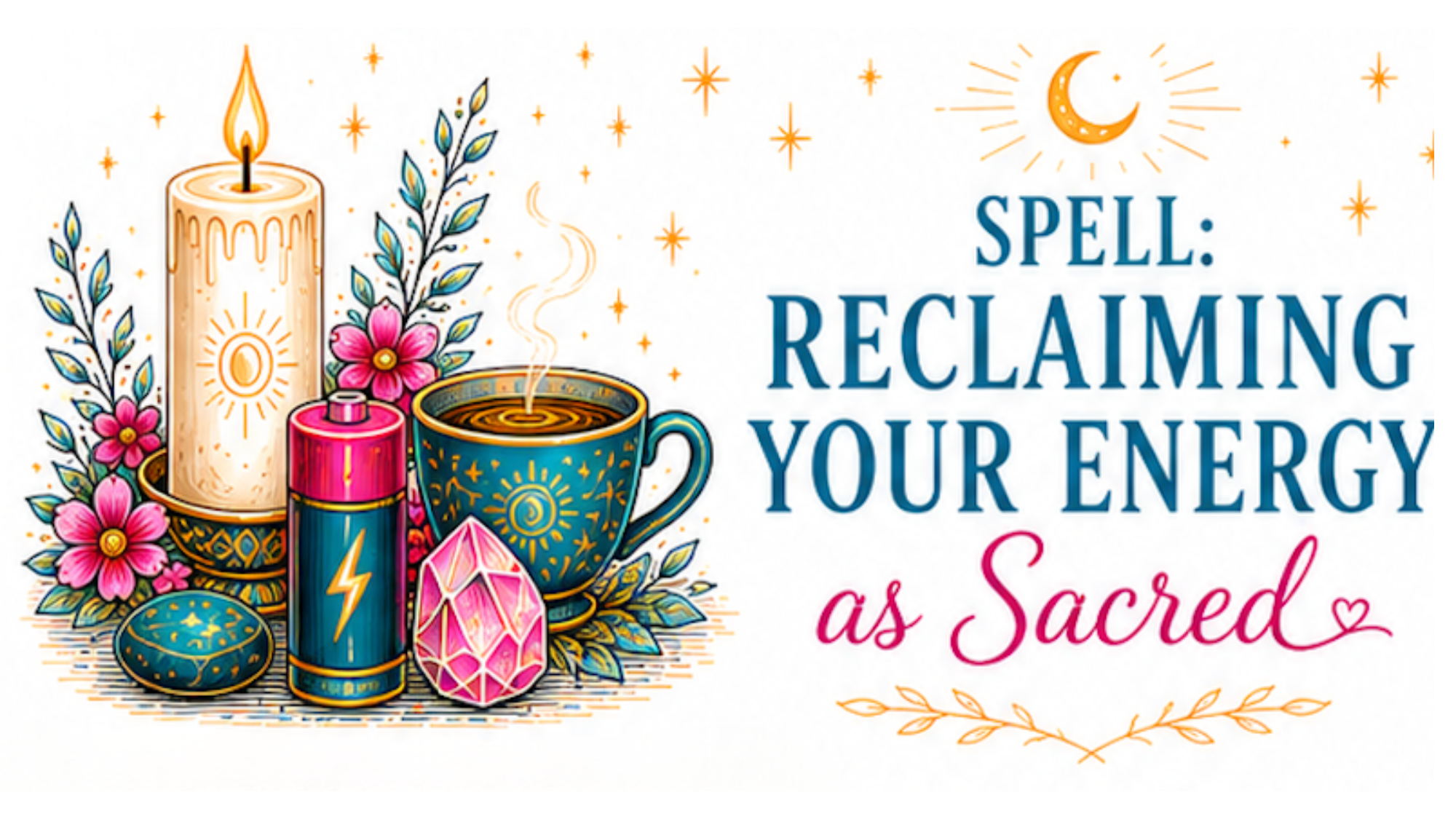
Spell: Reclaiming Your Energy as Sacred
A ritual for honoring your energy as your most honest currency
Intention
To recognize all forms of work as energy expenditure, to release inherited definitions of productivity, and to reclaim your energy as sacred, finite, and worthy of intentional use.
Materials
(Use what you have—substitution is part of the magic)
A battery (any kind; represents your energetic capacity)
A candle (white, gold, or magenta for clarity, vitality, or self-worth)
A journal or paper
A pen
A grounding object (stone, crystal, or even a small household item that feels steady—hematite, smoky quartz, or a simple rock)
Optional: a cup of tea or something nourishing (to symbolize replenishment)
Preparation
Find a quiet space where you can sit comfortably. Place the battery in front of you. Notice it—not as an object, but as a mirror.
This is you.
Not infinite.
Not empty.
Capable of holding charge.
Capable of being drained.
Capable of being replenished.
Light your candle. Take a breath.
Step 1: The Energy Inventory
In your journal, create three columns:
1. Where My Energy Goes
2. How It Feels (Draining / Neutral / Nourishing)
3. Chosen or Inherited?
Begin listing your current “work.” Let this be expansive. Include:
Your job or business
Emotional labor (supporting others, navigating relationships)
Physical care (cooking, cleaning, movement)
Mental labor (planning, decision-making)
Spiritual/creative work (journaling, healing, dreaming, building)
Invisible work (healing, grieving, becoming)
Take your time. Let yourself see the truth of your life.
Step 2: Witness Without Judgment
Read over what you’ve written. Place your hand on the battery. Say (silently or aloud):
“All of this requires energy.
All of this is work.
I honor the fullness of what I carry.”
Notice if anything softens.
Step 3: Release the Old Definition
On a new page, write: “Work is only what earns money, approval, or validation.”
Look at it. Feel where it lands in your body. Then gently cross it out. Below it, write:
“Work is anything that asks for my energy.
My energy is sacred.”
Pause here. Let that rewrite something inside you.
Step 4: Reclaim the Battery
Pick up the battery. Hold it in both hands.
Reflect:
Where have I been over-giving?
Where have I been under-nourished?
Where have I been spending energy to prove worth instead of express truth?
Then say:
“I am not here to run on empty.
I am not here to earn my worth through depletion.
I am here to use my energy in alignment with my life.”
If it feels right, gently press the battery to your heart or solar plexus.
Step 5: Choose One Shift
Return to your inventory. Circle one area where:
Energy is being drained unnecessarily
orNourishment is missing
Ask yourself: “What is one small, compassionate shift I can make?”
Examples:
Saying no to one obligation
Scheduling rest as real work
Asking for help
Reframing something as worthy, even if unpaid
Creating space for something that restores you
Write it down. This is your spell in action.
Step 6: Seal the Practice
Place your grounding object beside the battery. Let them sit together:
Capacity + stability
Energy + containment
Blow out the candle slowly.
As you do, say:
“I trust myself to tend my energy.
I trust myself to spend it wisely.
I trust that I am worthy of a life that sustains me.”
Integration
Keep the battery somewhere visible for the next few days. Let it interrupt your autopilot. When you see it, ask: “Is this worth my energy?” Not everything will be. That’s the point.
Closing Reflection
You are not a machine built for output.
You are a living system with rhythms, needs, and limits.
Your energy is not proof of your worth.
It is the medium through which your life is lived.
Spend it like it matters.
Because it does.
Download this Grimoire page and cast a spell to define your relationship to being valued, received, and allowed to exist without depletion.
The way you spend your energy is deeply connected to what you believe you have to do to be worthy of love. In a Love Spell Casting session, we explore those patterns together—so you can shift from depletion and overgiving into relationships that actually sustain you.